
Driving shouldn’t be a pain in the neck! The average Canadian spends 50 minutes a day in their vehicle commuting, not including being a passenger, vacations, or other purposes. This is enough time to cause pain if your posture is poor.
We know that almost everyone will experience some form of neck or back pain in their lifetime. At least 70 percent of neck or back pain begins with normal daily repeated activities like sitting in a vehicle. Most neck and back injuries are not from falling or lifting too much. They are from a buildup of repetitive strain and physical stress.

This is why proper posture is so critical to prevent strain in the neck and back.
Pain in the neck, back or shoulder areas due to poor posture and poor back support can build up gradually and may go away once a person stands up. It may go away and come back over months or years. But if poor posture continues then the strains and pressures continue to build.
The pain worsens and becomes more frequent. Neck soreness and stiffness may extend down into the shoulder blades and mid back. It may even spread into the arms. The pain can be a dull ache or sharp at times with movement and may cause headaches. Low back pain can start too and can spread into the hips and legs. The pains may be there just when driving, but it can eventually distract a person constantly and negatively impact their activities of daily life.
What causes pains from poor posture?
The cause of neck or back pain from poor posture in a vehicle is repetitive strain. This means small amounts of extra pressure and stress on the muscles and joints of the spine repeatedly over long periods.
The following pictures and discussion will help to understand this:
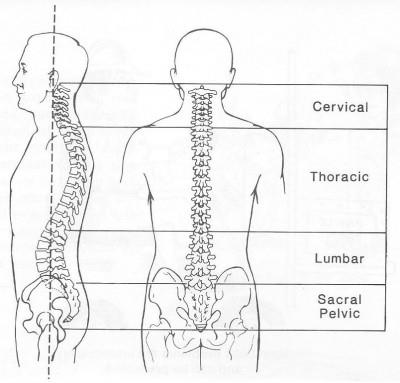
The human spine (neck, mid-back, and low-back) has three natural curves to it when viewed from the side (see diagram). There is a small curve (lordosis) in the neck towards the throat, a curve backwards in the mid-back, and a curve forwards towards the abdomen (lordosis) in the low-back.
If your neck and back is not positioned properly in these natural curves while sitting, then pain will develop sooner or later. These curves help the spine absorb shock and force and to stay balanced.
Try this simple experiment:
In order to understand pain that arises in your neck from poor posture, try the following experiment: Hold a bowling ball or a 5 kg weight/dumbbell in front of you with outstretched arms for 30 seconds as below:

Now hold it close, next to your body as below. Which position is easier to hold?

Guess what? that bowling ball is about the same weight as your head. If the head (bowling ball) is out front of the shoulders in a head forward posture, the neck muscles must work very hard to hold it there.
If the head is balanced on top of the shoulders properly, the neck muscles hardly work at all. If the head is moved far enough forward in poor posture, then it could be the same as 27 kg. (60 pounds) of weight being held up by the neck muscles. Normal force on the neck is minimal in a good posture.
The neck and back muscles are working too hard and for too long when the head is positioned forward. Even a bit too far forward creates large forces on the neck that add up with time.
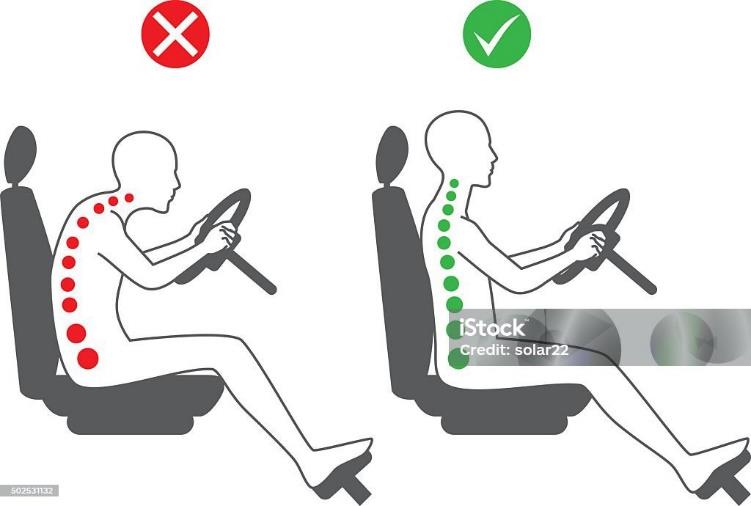
This experiment demonstrates repetitive strain on the neck and shoulders. The same idea applies to the low back. If seated in a poor, slouched posture, then the low-back has lost its natural inward curve, the neck has an increased curve forward, and the mid-back has an increased curve backwards (picture below). This position increases the stress on muscles and joints.
Repetitive strain is defined as small, subtle amounts of strain and force adding up. Whether its movement or stationary positions over extended periods of time. Like driving to work or sitting at a workstation.
A slouched posture not only make the muscles work too hard, but it puts the muscles, ligaments, and discs of the spine on an abnormal stretch. Pain can develop in minutes or hours or it can take months. If the posture is not corrected, eventually the muscles and ligaments will shorten and become tighter, and you lose flexibility in the neck and back. A loss of flexibility is also a major cause of back and neck problems.
So, pain from poor driving posture is caused by:
- too much muscle work
- too much repetitive strain on the joints of the spine.
Once the posture is corrected to the normal natural curves of the spine then the pain will go away.
What can be done to correct poor posture in a vehicle:
These are some easy adjustments that can be done to keep the neck and back in proper positioning:
- Use the lumbar support often built into the seat back as shown below:
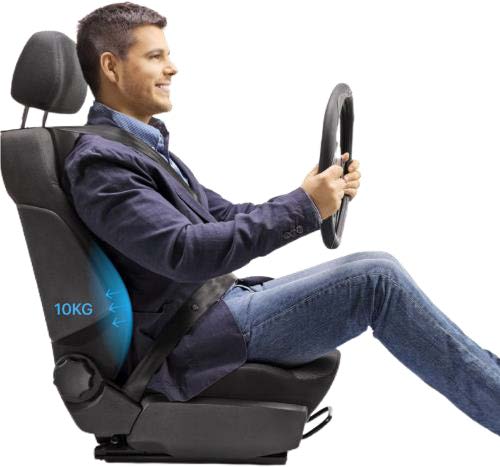
- Adding a lumbar roll is extra low back support and it supports the natural curve of low back as shown below. It also helps correct neck and mid back posture when the low back is positioned in its natural curve.
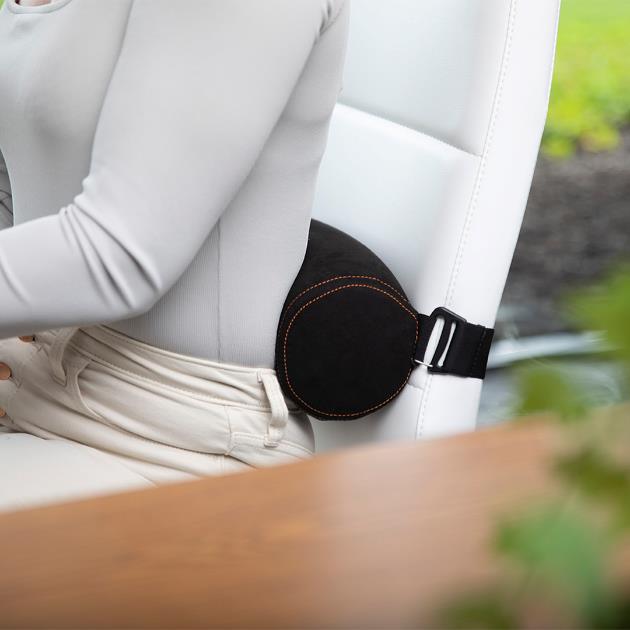
- Bring the seat forward to avoid overreaching of the arms and legs. If the arms and legs are extended too far this pulls the neck and back out of their natural curves. About a 120-degree angle at the elbows and knees is good.
- Adjust the seat back angle to near vertical, about 100-110 degrees.
- Adjust the head rest to align with the top of the head.
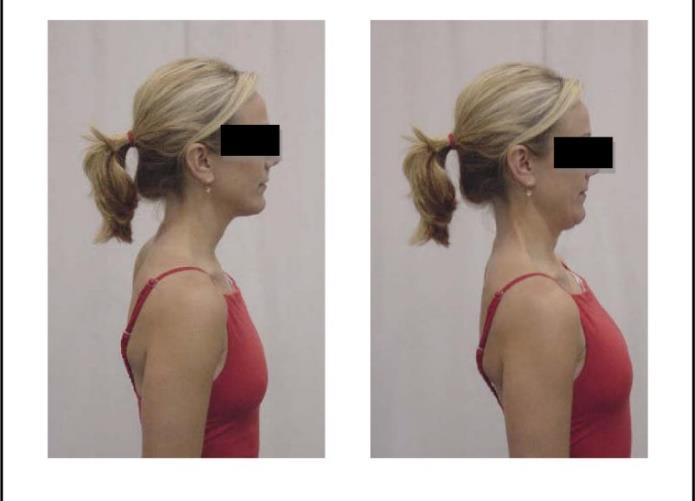
- Correct your neck position by bringing the head more over top of the shoulders into a more natural position-see picture below. A physiotherapist can help teach you how to correct your posture.
What else helps the pain?
Sometimes a physiotherapist is needed to help. They will address the causes of pain for a person to improve. If the cause of the pain is removed (poor posture and tight muscles) then the pain improves. Successful treatment comes with teaching a person how to lessen strain and stress on their neck and back. Treatment also focuses on teaching special exercises to reduce strain, stretch and strengthen muscles, and create faster healing.
Hands on treatment may be used to help ease the neck or back pain, allowing a person to move and enjoy life. To help pain and healing a physiotherapist may also use many proven treatments like ultrasound, heat, acupuncture, and gentle electrical therapy.
Patients are taught ways of easing the pain. Teaching self-treatment and promoting independence is a very important part of physiotherapy treatment. The physiotherapist is an expert in choosing the right exercises and techniques for each person.
What are the benefits of physiotherapy?

- Kill and decrease pain
- Heal faster
- Improve with less or no medication
- Learn how to treat neck and back pain on your own
- Understand neck and back pain and learn there are no mysteries
- Learn long term solutions
- Get back to your passions and pursue life!
References:
- Canadian Centre for Occupational Health and Safety. (2025, February). Driver ergonomics fact sheet.
- McGill, S. M. (2002). Low back disorders: Evidence-based prevention and rehabilitation. Human Kinetics.
- McKenzie, R. (1993). Treat your own neck. Spinal Publications.
- McKenzie, R. (2003). The lumbar spine: Mechanical diagnosis and therapy. Spinal Publications.
- Saunders, D. (1990). Cumulative trauma: Reducing the risk (Self-help manual). Educational Opportunities.
- Saunders, D. (1990). For your neck (Self-help manual). Educational Opportunities.
- Physiomed UK, (2015). Correct driving posture article.